This July we held an incredible seed trainee field trip to the heritage seed library, at Ryton , Coventry. A joint visit by trainees from the Northern and South Western groups on the year long seed sovereignty training. Our hosts Catrina Fenton , Marcin Salnikow and Rachel Crow demonstrated various techniques explaining the workflow of their systems of seed saving, sorting, storage and distribution.
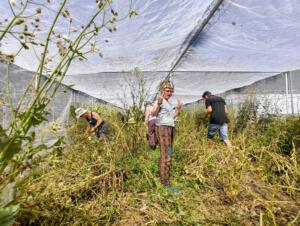
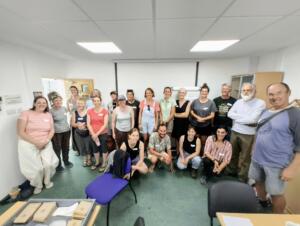
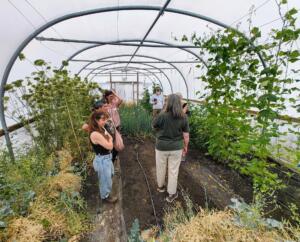
A thoroughly engaging day that dived into the processes and purposes of the work.
Catrina reaches into the aubergine patch, in her hand a tuning fork vibrating to simulate a pollinating insect, The flower releases a dusting of pollen. When collected from each flower, mixed and dabbed onto the other flowers with a paintbrush, it ensures an even spread of the selected genetic materials across the range of plants.
The selection criteria is ‘true to type’, individual plants that drift away from the recorded description being rogued out to maintain phenotypical consistency through the selection of best examples. Rachel points out the rare characteristic white hilum of the St.Gorran landrace broadbean, and rogues out the few in the mix that have a darker tone.
With so many varieties it’s an incredible feat of overlapping time and space segment planning. Marcin has mapped out these planting plans for over a decade, separating spaces and flowering timings like a four-dimensional Tetris player.
Choosing good examples of phenotype and only allowing those plants to pollinate that match the recorded descriptions held for each variety. Where multiple varieties of the same plant exist, they are grown in isolation nets, polytunnels and separate glasshouses to prevent cross-pollination, and also observe and check plant health whilst managing pests. Only plants from different families that will not cross are grown in the same space, often curating a tunnel with a single brassica, bean , tomato and allium. The importance of keeping these varieties ‘true to type’ is not lost on this innovative team, to safeguard these diverse stewarded genetic profiles for the future is their vision.
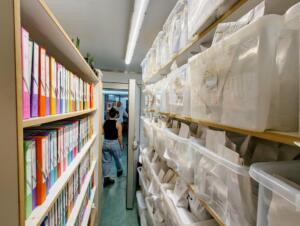
This style of seed crop management allows them to achieve the objective, staying ‘true to type‘ and not cross pollinating. The work of stewarding heritage and heirloom varieties that would otherwise potentially be lost, and with good reason, as many of their varieties historically were used commercially, but have since fallen from the lists, adding to the loss of a large percentage of vegetable varieties over the last hundred years. The continued work at the heritage seed library effectively helps mitigate this deleterious effect, a counterbalance to myopic industrial scale commercial growing, the driving force behind diversity loss.
Their commitment is a labour of love, a passionate vocation, and this is tangible in the enthusiasm and contentment they express with doing this work. Safeguarding these diverse genetic varieties so they can be used in the future is the mission. With over eight hundred varieties and more added every year. I feel it won’t be long before there will be a thousand. I hope to celebrate that day with them as it’s an incredible accomplishment.
And I’d also like to thank them from the heart, a debt of gratitude, over the last twenty years as a long time seed swap enthusiast, I have received heritage seed support for many swap tables from the Heritage Seed Library, (one time Henry Doubleday research centre), their generosity with packets of heritage seed have been most welcome. With their yearly updated national seed swap lists, and seed saver resources being testament to their commitment to the cause as they continue to be an inspiration.
– Matt
