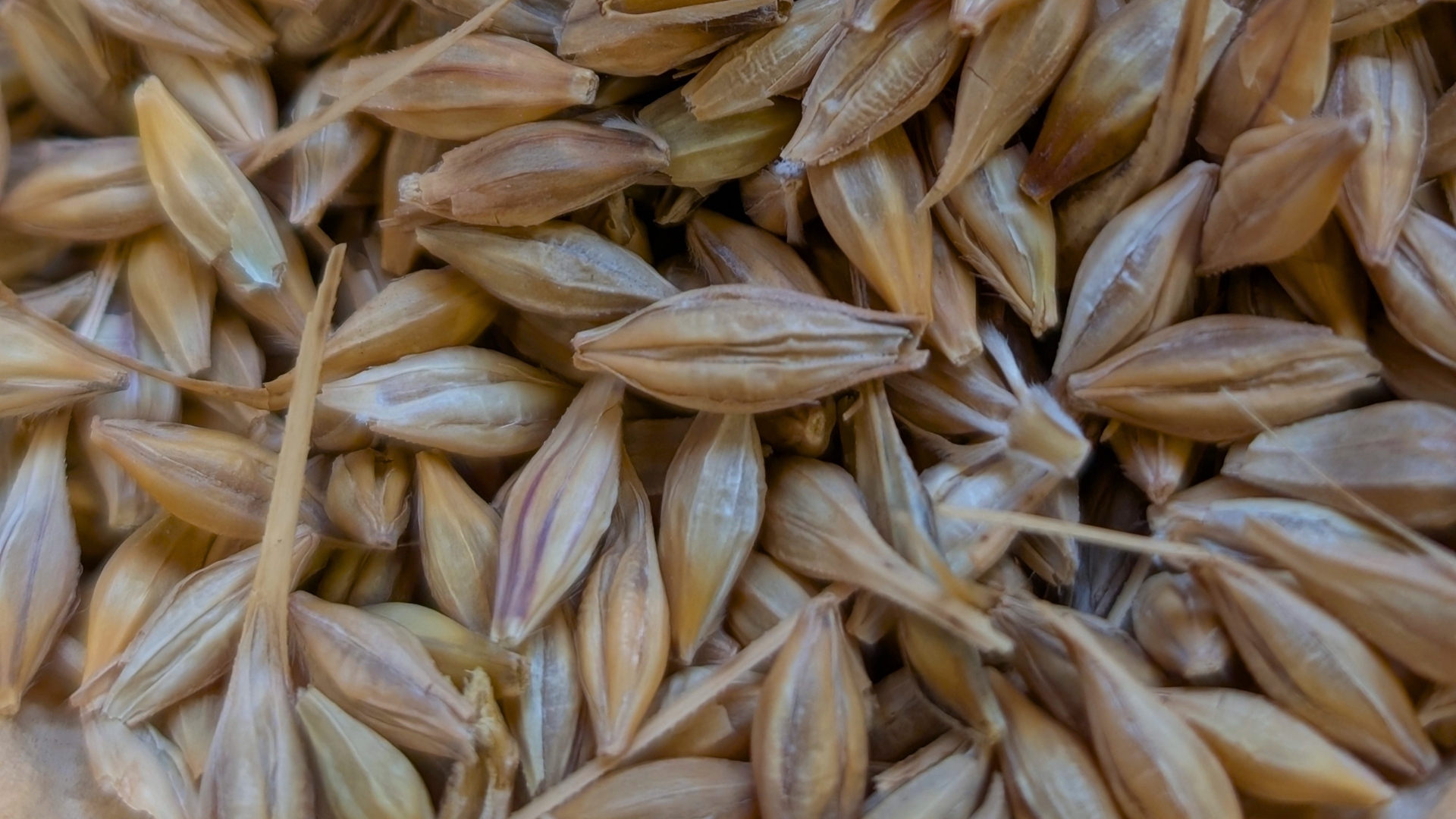
Grains are a central part of our global diets. Nutrient-rich and a vital source of fibre, vitamins, and minerals, we have evolved alongside cereal crops for millennia; almost every country boasts its own delicious cultural bread dish. Harnessing the wonderful potential of these golden kernels, our ancestors once stewarded untold quantities of regionally adapted grains, each with their own unique characteristics. Today, this incredible diversity of grain seed is no longer sown in our fields. Over 500,000 wheat accessions are stored in global gene banks, each containing their own untapped possibilities. But this diversity is confined to the walls of the seed banks.

When it comes to UK grain production, it is difficult to avoid the apocalyptic image of monoculture cereal fields, harvested by huge machines. Of the 49% of farmland in the UK used for arable crops, 60% is made up of just 7 varieties of wheat. Where in the past we would have enjoyed a patchwork of fields full of regionally specific grains, all adapted to their bioregions and to the needs of the communities using them, we now have fields of genetically uniform crops serving an industrialised food system.
The rest of the grain chain tells a similar story. 65% of flour milled in the UK comes from 4 mills. Where diverse grains were once fed into regional mills, resulting in a diversity of different flavours and foods, we are now heading towards a far blander food picture. With 99.8% of UK households buying bread, very few loaf eaters are asking where their wheat comes from, let alone what variety of wheat made their bread.
If we want to build a resilient future food system, we need seed diversity as the foundation. We need grain crops ready to respond to the unpredictable climatic changes coming their way; crops that can withstand drought, floods and new temperature fluctuations.
Adaptation requires a bank of genetic diversity to draw from; to allow this diversity to be stamped out would be folly. Diverse grains are the foundation of a more beautiful world; they encourage more abundant biodiversity, more diverse flavours, which in turn ensure we have a diversity of delicious foods. They germinate local grain systems, offering an array of livelihoods as diverse as the communities they are a part of. Increasing the diversity of our grains is a powerful tool for wider systems change.

The good news is that there are islands of people working to revive grain diversity, and their work is proving rather infectious. UK Grain Lab is a vibrant movement of people working together under a broad umbrella, connecting dozens of enterprises and hundreds of individuals. They have incubated a growing number of regional grain networks across the UK: collectives of people, usually made up of farmers, millers, bakers and researchers, all working together to bring diverse grain production back into their communities. A glance at the UK Grain Lab alternative grain group map is enough to make your heart soar, covered with pins showing hundreds of mills, bakeries, farms and communities working to revive regional grain economies. Look closer and you will see old heritage varieties of grains being restored and new genetically diverse populations of grains being developed. Under the surface, grain diversity is growing in the UK.
Diversity works on many scales. A bird’s eye view looks at the diversity of grains growing from field to field. We certainly need to see grain crops vary across our landscapes, ensuring that regionally specific and unutilised grain varieties are being grown. If we look a little closer, we see the importance of the diversity within each field. There is growing awareness that genetically diverse populations of grains can provide far more resilience to changing climatic conditions than the more genetically narrow varieties bred for uniformity across the field. When a grain population contains individual plants that have the ability to respond differently to their conditions, we hedge our bets, ensuring that at least some of our population will thrive. Zooming in closer still, we can see the importance of diverse genes within each plant and the need for breeding grain crops with the possibility to adapt to unknown future challenges. Studies have found that modern wheat varieties use only about 40% of the genetic diversity found in historic collections, meaning 60% of potential genetic diversity is unused in modern breeding. There are a multitude of scales to work at, each with their own possibilities for the future of grain sovereignty.

Reviving grain diversity is no simple thing. Grain chains are complex. If a grain seed is to be eaten, it needs to be grown, processed, stored, milled, baked and distributed. Grain seed revival involves working across the entire grain chain, from seed to plate. Depending on your perspective, this is a huge challenge. It also presents a huge opportunity to work cooperatively across sectors and backgrounds, constructing a vibrant new grain system built on seed diversity.
Grains seem to ignite a unique excitement in people. Perhaps it is our long history of co-evolving alongside cereals? Perhaps it is the central place that bread takes on our tables across cultures? Perhaps the scale with which we imagine grain production offers an easy leap to imagining large-scale change to our food systems? It could also be the air of mystery that grain growing holds for many people, who think of cereal production as the domain of large-scale arable farmers. Nevertheless, we are seeing a rise in energy from people who want to bring grain production back into their communities. They want to demystify the grain-growing process. Rather than grow genetically narrow modern cereals, they want to engage with the exciting possibilities in underutilised diverse grains: remembering their regional food cultures, reviving local supply chains, reconnecting with the soil, restoring their microbiomes, eating delicious unprocessed food.

Responding to this emerging energy, we have been designing a new Year-Long Grain Seed Production training programme. Working with the seed activists already forging the way to rebuild community-scale diverse grain systems, we have designed this training for those wanting to grow on a small to medium scale, with grain diversity as the foundation. Covering topics such as seed sourcing, plant botany and selecting for quality, the course aims to give people the skills to take smaller quantities of rare grains and grow them for seed: the foundational step in the long journey of making these grains more widely available.
One of many hand-selected teachers sharing their wisdom is Lisa Housten, who will be leading the sessions on small-scale cultivation and harvesting. Lisa has been navigating the choppy waters of community grain production for several years in her work to bring wheat and rye production back into farming rotations at Lauriston Farm, in the heart of Edinburgh. On this community farm, grain crops are currently grown on 3.5 acres. In 2024, with no machinery and an acre of grain to harvest, 200 people came together and harvested every stem by hand with scissors.
“It has been difficult to find resources for how to grow grain at this scale. In some respects, we have had to patch the information together and experiment”, says Lisa. Coming from the perspective that grain production should be part of mixed farming practices, Lisa believes that growing grain amongst other crops on the farm brings important diversity to the land and community. She will be sharing some of their first-hand learnings in our training, looking specifically at how to cultivate and process grains on a ‘human scale’, often using vintage machinery or person power. “Growing grains at this scale is exciting, it allows people to engage with the crops in a way you cannot do when growing over hundreds of acres”.

Recognising the need to look towards reviving grain diversity on larger scales, we are working with Fred Price of Gothelney Farm in Somerset. Fred has been running this 150-hectare family farm agroecologically for 12 years now, producing meat and cereals. Realising that monocultures simply don’t work for farmers, Fred says, “If you’re a farmer embedded within the commodity system, you don’t set your price. Your only levers for profitability are yield and scale…I’m advocating for something more diverse and complex”. Fred grows many diverse and underutilised grains on his farm, including heritage wheat mixes, such as his blend of red lammas, Percival’s blue cone and hen gymru. He is also engaged in breeding new genetically diverse wheat populations, strengthening the resilience of his grain crops. Stating that there should be no separation between breeders and growers, Fred recognises that grain diversity should be stewarded by farmers themselves.
Fred will be teaching our training sessions on the practicalities of larger-scale wheat production, offering some wider context to those starting out in growing grains. Facilitating conversations around quality and end use, we hope to learn from Fred’s experiences bringing rare seeds into his fields. Stepping further towards grain diversity, we will hear from Fred about creating genetically diverse populations, cultivating diversity ‘plant to plant’ as well as ‘field to field’.
While taking part in our course, trainees will be asked to grow three wheat crops. Starting at the small, educational scale of 10m x 1m strips, these crops will serve the purpose of bringing our theoretical learning into real life form. Trainees will use these educational crops as the basis for their seed journals, recording their reflections and learnings. The wheat we will grow together will be selected from trials hosted by UK Grain Lab, offering a chance to compare an older wheat with a more modern variety, as well as a more genetically diverse wheat with a more uniform wheat.
While the course is focused firmly on grain seed, we cannot facilitate conversations about cereals without bringing the wider historical and political context of grain revival into our understanding. Robyn Minogue and Chris Maughan from the South West Grain Network will teach our training session on grain sovereignty. This workshop will look at the politics of grain production in the UK, inducting trainees into the grassroots movement of regional grain networks who are working to revive grain diversity across the UK. The South West Grain Network is a community who are taking “active steps into an alternative grain economy, one that is human scale, non-commodity and grounded in friendship and collaboration”. Their mission is to bring the three Ds into the UK grain system: democracy, decentralisation and diversity. Not only reviving diversity in the fields around them, but also reviving regional foods and artisanship.

Aware of the beautiful complexities of grain seed revival, we do not claim to have all the answers. Our training programme is a pilot, designed to be the first iteration of something which can be built upon year on year. While our core driver is to increase grain diversity, we are aware that the path to get there might not be a simple cause and effect. Leaning into the principles of emergent strategy, our training is focused on building a community of practice; we intend to foster peer-to-peer learning, problem solving together.
We cannot promise that all the underutilised grains our trainees cultivate will make it into farm-scale fields or commercial grain chains. But we can wholeheartedly say that taking the first steps on a journey to grain diversity revival can be enlightening and rewarding. Far more powerful than the course content itself is the bringing together of like-minded people with a passion to diversify their local grain systems. Rare seeds are safer in many hands. By building networks, we are widening the safety net which will catch the diversity we are losing. When we have more growers putting their energy into building grain sovereignty, we have the possibility for more unwritten solutions to emerge. This is where the real power is.
Find out more about our new Grain Seed Production Training here.